Maybe one of the reasons we missed A.I. on our Future Bucket List is that, like fusion, it was one of those technologies that was always coming, but never quite here. Until it was.
Alan got his first exposure to something called A.I. through Joseph Weizenbaum’s 1976 book, Computer Power and Human Reason. In particular its ELIZA natural language processor.
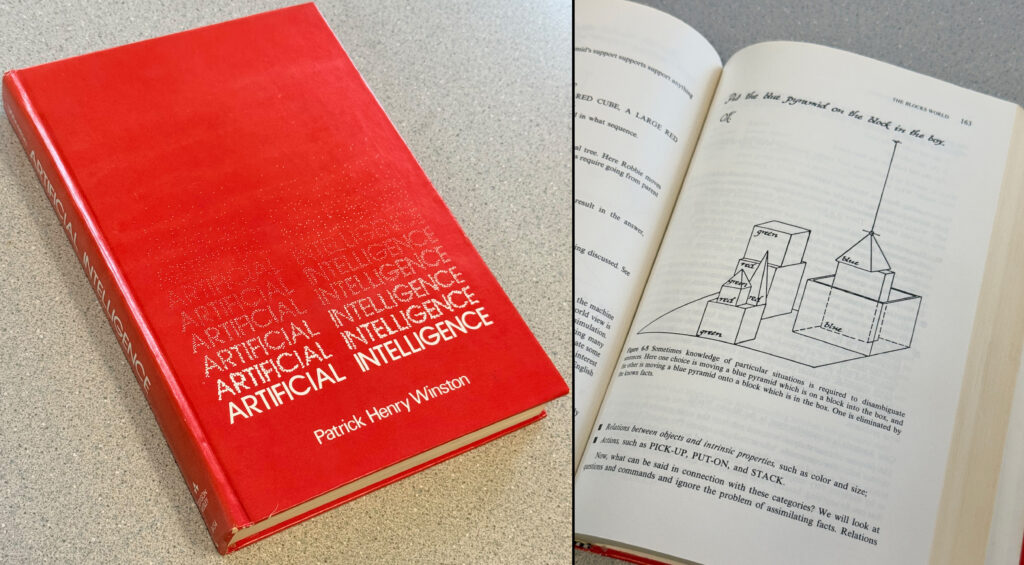
Next up was a required course at M.I.T. Its title, what else? “Artificial Intelligence.” The course and textbook (you can guess the textbook’s title) were taught by Patrick Wilson, longtime director of the MIT Artificial Intelligence Laboratory. A major part of “A.I.” at that time: recognizing and stacking blocks.
Another big part of A.I. at the time was game theory. Alan’s Microprocessor Lab project was a device that played a decent game of Othello. Alan also studied LISP, a (parenthesis-heavy) programming language that was used in early A.I. research.
When Alan got to Apple in 1983, there wasn’t much A.I. to be found, until 1987 when John Sculley debuted a series of “Knowledge Navigator” videos. The agentic technologies they portrayed seemed (and were) awfully far out at the time.
A.I. as game theory was again in the news in 1997 when a computer beat the reigning world chess champion, Gary Kasparov. The world was able to follow the multi-day match through a new medium: the World Wide Web. Since that time, computers have only gotten better, and humans haven’t. It’s now no contest.
Speech recognition and natural language processing were always an assumed part of “A.I.” After decades of research, Apple brought the state-of-the-art in these fields to the masses with Siri in 2011. Other “virtual assistants” like Amazon’s Alexa soon followed. Siri, Alexa and others continue to add new features, approaching many Knowledge Navigator capabilities.
And then there was the oddly-named but game-changing ChatGPT (GPT for Generative Pre-trained Transformer), released in late 2022. OpenAI’s ChatGPT established a new definition for A.I. and set off the ongoing “A.I. boom.” Generative A.I. and large language models from other startups soon followed.
So what will tomorrow’s A.I. look like? Stay tuned!