
Many technologies are left behind as an accidental side-effect of the adoption of newer technologies. For instance the decline of the post office. Or “video killed the radio star.“
But some technologies are left behind intentionally, often with a very complex planning cycle to do so.
In the 1990s it became clear that there was a much better, more efficient form of television than that which had been in use since the 1940s. But unlike the backward-compatible 1950s upgrade from black-and-white to color TV, the broadcast of high-definition digital TV (HDTV) was going to require the replacement of the previous (analog) technology.
Here in the U.S., that replacement took over a decade. Broadcast HDTV was not only going to obsolete every television being used to receive over-the-air signals, but also a number of popular recent innovations like video cassette recorders (VCRs) and TiVos (remember those?).
Clearly a “transition strategy” was needed. There were both technical and societal challenges. For instance the FCC would have to allocate additional spectrum to broadcasters so they could broadcast in both analog and digital during the transition (despite a big goal of the switchover being freeing up and reallocating the large analog TV spectrum).
More relevant to most of us was how to prevent our then-current devices from breaking. The plan was a “converter box,” which would take the new digital signals, convert them back to analog, and feed them directly into the TV, VCR or other device.
These converter boxes were going to be an added expense, especially for lower-income families (many of those with higher incomes had switched to cable or satellite TV systems). So Congress allocated nearly $1.5 billion for $40 coupons which would let people purchase converter boxes for close to nothing.
Starting in early 2008, families could apply for up to two coupons per household. Applications could be made online (a somewhat new technology in its own right), or through legacy technologies like toll-free phone, fax or even the U.S. postal service.
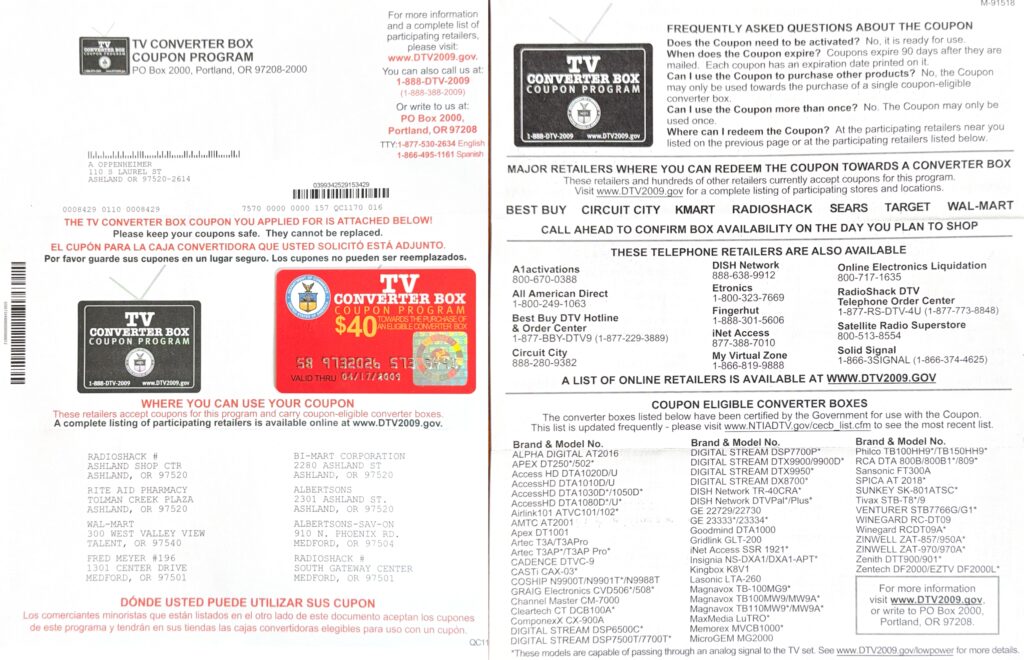
Converter box coupons were a key part of the planned demise of analog TV. Perhaps of greater historical interest, the list of retailers where those coupons could be used turned out to be an unintended preview of the unplanned demise of many of those businesses.

The digital TV switchover date was originally set for 2006, but was delayed a number of times. Finally on June 12, 2009, the broadcast of analog TV signals, going on for well over half a century, joined the ranks of past technologies left behind.