… and at times incomprehensible too.
One of the more “far out” (or so we thought) items on our Future Bucket list was quantum computing. It’s also one of the more “technically challenging,” to put it mildly. A recent paper on the subject in Nature is entitled “Observation of constructive interference at the edge of quantum ergodicity”.
And if you think that’s a challenging title, wait until you see the abstract, included here just for fun (emphasis on terms contributing to general incomprehensibility added):
The dynamics of quantum many-body systems is characterized by quantum observables that are reconstructed from correlation functions at separate points in space and time1,2,3. In dynamics with fast entanglement generation, however, quantum observables generally become insensitive to the details of the underlying dynamics at long times due to the effects of scrambling. To circumvent this limitation and enable access to relevant dynamics in experimental systems, repeated time-reversal protocols have been successfully implemented4. Here we experimentally measure the second-order out-of-time-order correlators (OTOC(2))5,6,7,8,9,10,11,12,13,14,15,16,17,18 on a superconducting quantum processor and find that they remain sensitive to the underlying dynamics at long timescales. Furthermore, OTOC(2) manifests quantum correlations in a highly entangled quantum many-body system that are inaccessible without time-reversal techniques. This is demonstrated through an experimental protocol that randomizes the phases of Pauli strings in the Heisenberg picture by inserting Pauli operators during quantum evolution. The measured values of OTOC(2) are substantially changed by the protocol, thereby revealing constructive interference between Pauli strings that form large loops in the configuration space. The observed interference mechanism also endows OTOC(2) with high degrees of classical simulation complexity. These results, combined with the capability of OTOC(2) in unravelling useful details of quantum dynamics, as shown through an example of Hamiltonian learning, indicate a viable path to practical quantum advantage.
Maybe ChatGPT could help make things more comprehensible? Not really.
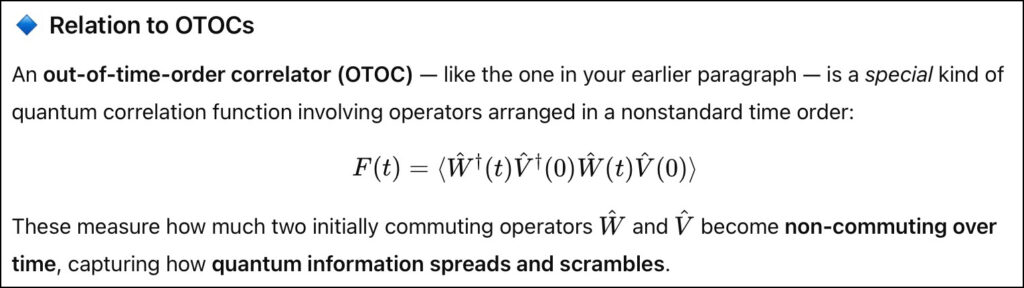
Emphasis not added 🙂
And of course whether ChatGPT got any of this right is itself pretty much indeterminate. Talk about hallucinations!
Coming back around to reality a bit, it should be noted that this paper is authored by “Google Quantum AI and Collaborators” and that Google includes a slightly less incomprehensible version of the paper on their blog. One of the collaborators, Michel Devoret, even just won the Nobel Prize in Physics.
Big companies like Google can certainly afford to spend a small portion of their cash hoard on seemingly far out technologies. Beyond Google and the usual array of start-ups, IBM, Microsoft, Nvidia, Amazon and Intel all have made recent large investments in this indeterminate Future.
IBM, Microsoft and Amazon even claim to offer access to cloud-based quantum computing.
So it seems the quantum computing Future may not be as far out as we think. But it still remains just as incomprehensible!