While we were reviewing the past year, and adding a couple A.I. items to our Future Bucket List, we came up with one more.
Going to space. As in “Priscilla and Alan go to space.” Current Future Bucket List technologies include “People on the Moon (again)” and “People on Mars,” but Priscilla and Alan are very unlikely to be any of those people.
Our getting to “go to space,” however, seems more likely. “Space tourism” actually started in 2001, and a number of companies now offer “trips to space.” If the price is right.
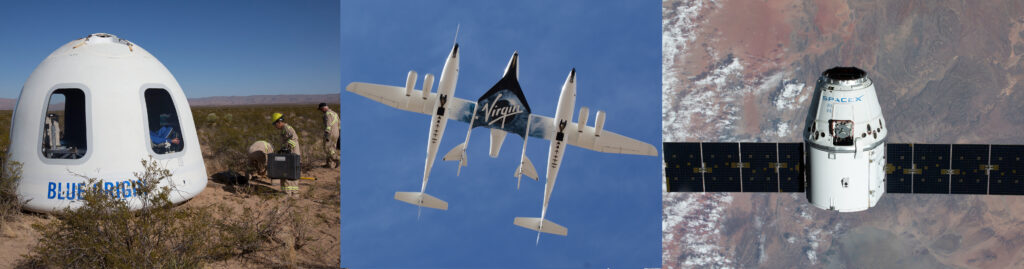
- Blue Origin says: “Return to Earth, Forever Changed.” They just completed a flight this week.
- Virgin Galactic is launching a new space age, where all are invited along for the ride.
- SpaceX invites you to Join a Mission.
- Axiom Space suggests “Let’s take flight.” They use SpaceX hardware.
A big question is how “space” is defined. A simple and usually accepted definition is space starts at the Kármán line, 100 km (62 miles) above sea level. There are technical reasons for this definition, but functionally it’s above where airplanes can fly (not enough atmosphere to get any lift) and where the sky is fully black (not enough atmosphere to scatter sunlight).
Interestingly, the definition of space does not have anything to do with weightlessness, which many of us have already experienced here on planet Earth. Think rollercoaster or ski jump.
The Kármán line also effectively differentiates the two current options for space tourists. Blue Origin and Virgin Galactic offer short sub-orbital flights that just barely reach the Kármán line. Space X and Axiom’s flights are orbital and go much higher (and longer). They also cost about 50 times more!
To put some numbers and scale on things, there have only been a couple dozen sub-orbital tourism flights, minutes in length with current pricing around $500,000. There have been even fewer orbital tourism flights (most to the International Space Station), days in length at about $25 million each.
There are all sorts of other factors of course, like amount of training needed, physical requirements, launch sites, etc. And space tourism doesn’t seem to obey Moore’s law (yet), so it’s not clear when or if its requirements will become more practical.
But that’s one of the fun things about our Future Bucket List: as stated, it’s “technologies that we wonder if we’ll see in our lifetimes.” Emphasis on wonder.