Scientists at the University of Minnesota have created, from scratch, a prototype of a living cell. It’s not quite life, but almost.
From an ingredient list consisting of basic chemicals, a team led by Dr. Kate Adamala created “SpudCell,” a synthetic single cell that performs many of the key aspects of what we consider life: feeding, growing and replicating (a full “cell cycle“). It needs a bit of “outside help” in this process, which is why it isn’t quite life.
Previous work by Craig Venter and others in this area used a “top down” approach, starting with a living cell and synthetically changing it to be a different form of life. Adamala worked “bottom up,” starting with basic ingredients to get near to the same result. It’s just a matter of time before these two approaches meet.
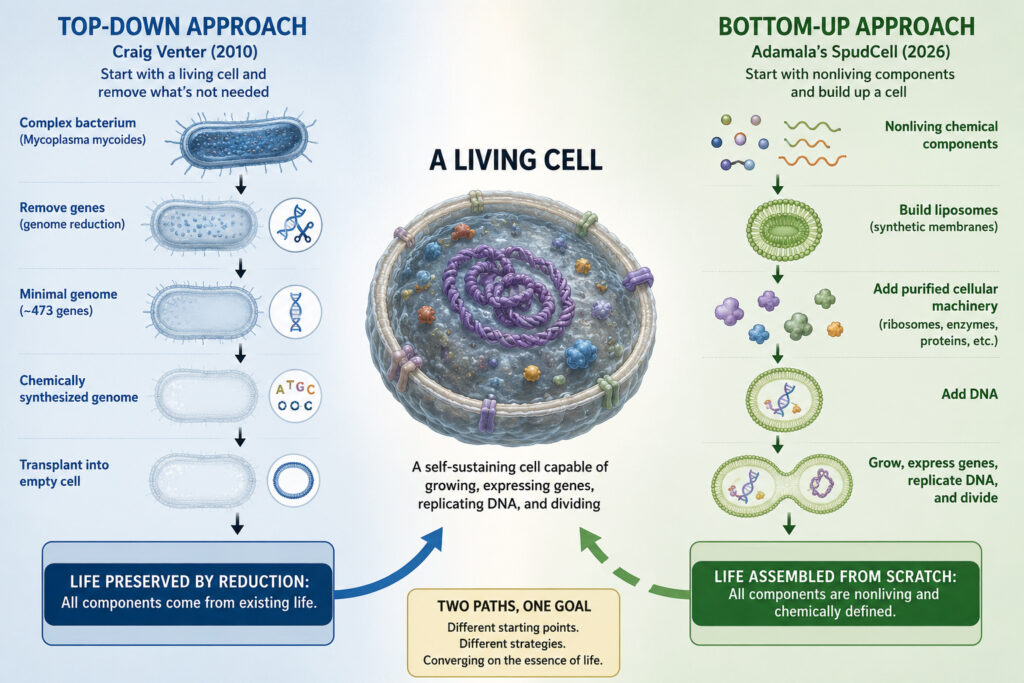
Prototypes often leave some of the hardest problems for later in the interest of making serious progress on the design as a whole. That’s what Adamala’s team did. SpudCell can not manufacture its own ribosomes, relatively complex structures used in creating proteins. So those have to be fed to it from outside. Spudcell also needs help in the replication process, another complex function.
An interesting benchmark is that SpudCell (not quite life) only contains about 90,000 DNA base pairs and 36 genes, whereas Venter’s cells (minimal life) contained about 530,000 base pairs and 470 genes. There is just one order of magnitude before the two meet.