Crowds are usually something you want to avoid, although by their definition, you often can’t. But crowds are something that event organizers and technologists often look for. A crowded talk, event, or website is often a good thing.
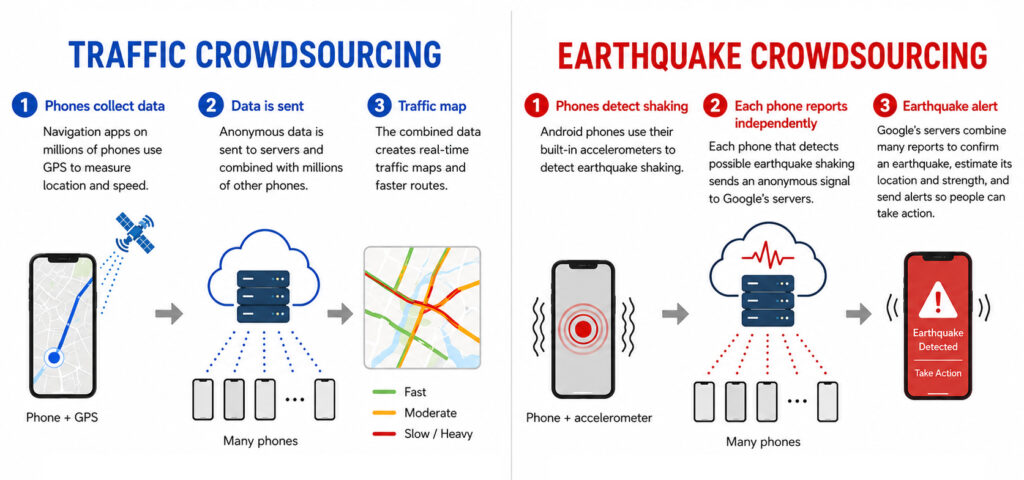
Crowdsourcing is a natural extension of the positive aspects of crowds. We use it, for example, any time we “check traffic” before starting a commute or heading off on a road trip. In this case, “the crowd” is all of us in our cars with our cell phone and GPS. It’s an ingenious combination of technologies, pioneered by Google.
Google was equally inventive with the crowdsourced Android Earthquake Alert System, which provided critical seconds of warning in the recent Venezuela earthquakes. In this case it was crowds of cell phones all (literally) jumping up and down at the same time, as measured through their accelerometers.
There are a number of other interesting examples, some of which date back centuries. In 1714 the British government asked “the crowd” for help by sponsoring a contest to reliably determine longitude, which was essential to ship-based navigation. “The crowd” back then was a lot smaller, but the contest worked.
In 1884, the first installment of the venerable Oxford English Dictionary, decades in the making, was finally published with crowdsourcing help from hundreds of volunteers. The full OED would not be completed until 1928.
Back in the Present, other recent successful crowdsourcing efforts include (in approximate chronological order):
- The XPRIZE foundation (seeking to replicate the British government’s success from 300 years ago)
- SETI@Home (hasn’t shown positive results, but still could)
- Wikipedia (crowdsourced since its inception in 2001)
- Protein Folding@Home
- All of Us (Alan & Priscilla’s favorite)
- Purple Air (air pollution monitoring, especially around wildfires)
- Watch Duty (wildfire monitoring)
And then of course there’s the Future. That’s where Alan and Priscilla’s Sequencing@Home idea lives. It’s also where a couple items from our bucket list will hopefully come into play.
There are 8 billion people out there in the world, with close to 8 billion cell phones. We’re looking forward to what they (we) come up with.