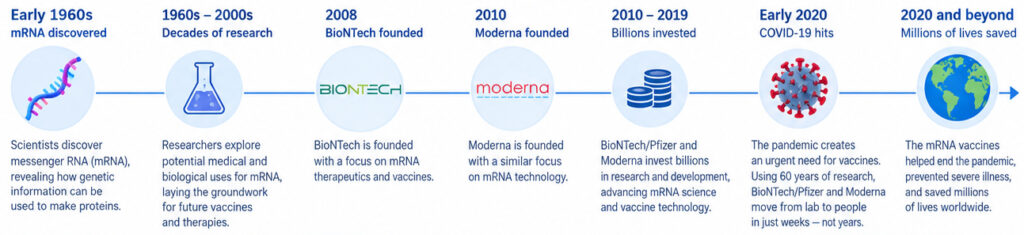
Messenger RNA (mRNA) was discovered in the early 1960s. Decades of scientific research into potential biological and medical uses followed. That research ultimately led to a number of commercial medical ventures, in particular BioNTech in 2008 and Moderna in 2010.
The new companies invested billions of dollars in research and development over the next decade, which finally paid off (for the whole human race) in early 2020 as the COVID-19 pandemic hit. BioNTech, partnering with Pfizer, and Moderna on its own, were able to take advantage of 60 years of science to create highly effective mRNA-based vaccines in a matter of weeks, rather than the usual years. Estimates vary widely, but there is no question millions of lives were saved as a result.
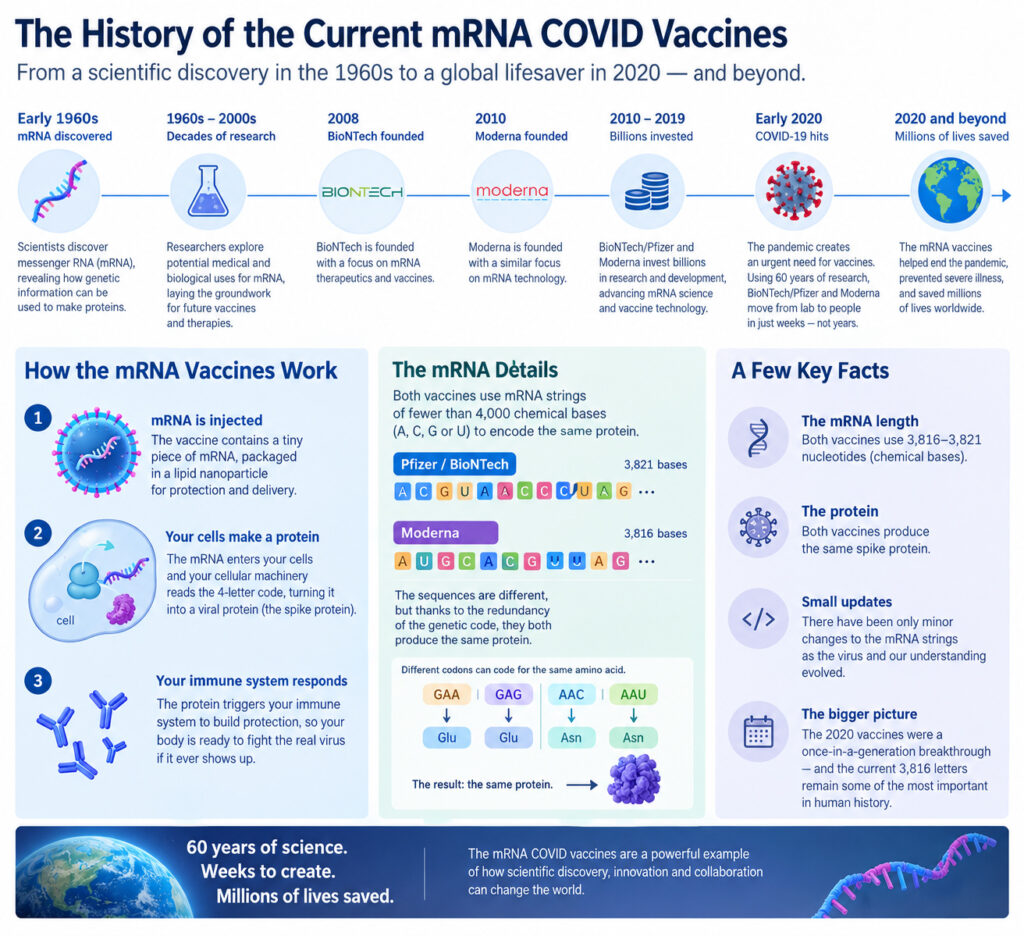
Although there were slight functional differences, the Pfizer and Moderna vaccines worked the same way. Their central mRNA component consisted of fewer than 4000 chemical bases, each represented by the letter A, C, G, or U. When strung together, packaged and injected as a vaccine, the body’s cellular machinery turned the mRNA letters into a protein which prepared our immune system to fight the invading virus.
An interesting aspect of these critical 4000 letters is that they differed slightly between the two vaccines. Equally interesting was the fact that the resulting proteins were exactly the same. The redundancy of the human genetic code is such that different strings of bases (specifically codons) can result in the same amino acids, which then make up the same protein.

There have been only very minor changes to the mRNA strings encoded in the original 2020 vaccines, as the COVID-19 virus and our understanding evolved. The current 3,816 letters of both vaccines remain some of the most important ones in human history.**
* Here’s the full “public service announcement” that ChatGPT created based on the above post:
** 3,816 letters is approximately the size of this blog post, including the letters in the diagrams. It’s about half the size of another set of historically important letters: the Declaration of Independence.